


Want to get Faster? Speed and Plyometric Jumping Hacks
If you want to get faster, more explosive aka quicker you have to increase Mass or Force into the ground (weight/Load) and Acceleration (Speed). Force = Mass x Acceleration (F=MxA) or Acceleration = Velocity over Time (A=V/T). Simply if you increase load or weight (mass) on a squat or vertical jump you have the potential to be faster. In addition, if you can improve speed (acceleration) you also have the potential to be quicker. Or if you improve the ability to apply more force into the ground and accelerate faster that you potentially will have a better forty yard dash time.

1. Box Squats with Velocity Base Training Devices (VBT) (RFD)
Box squats or a deep barbell squat with Tempo is a great tool for increasing explosive power and helping improve force for sprint. The more weight you lift, the more potential your speed can improve. Box squats are tempo barbell deep squats with a pause at the bottom of the squat. This allows for inertia to zero out, thus creating no momentum or stretch-shortening cycle or that elastic sling-shot effect that helps stand up easier. Basically if you go down and reverse directions quickly your body cheats using the elasticity in the tendons (SSC or stretch shorten-cycle). The key to the box squat is a static-dynamic method that separates all three movement phases into individual parts, going down (eccentric or lengthening phase) then pausing at the bottom (isometric phase or pause/hold) and then quickly exploding up (concentric or shortening phase). The pause then going up quickly improves rate of force development (RFD) which is the key to quick starts off the line.

By using the body weight to squat ratio you can figure out your potential forty yard dash time. Divide your Squat weight (1RM) divided by your body weight (BW).
Squat weight / Body Weight = Squat Ratio
BW : Squat (Ratio) | Pred. 40 yd (sec.) |
0.4 | 6.0 |
0.5 | 5.9 |
0.6 | 5.8 |
0.7 | 5.7 |
0.8 | 5.6 |
0.9 | 5.5 |
1.0 | 5.4 |
1.1 | 5.3 |
1.2 | 5.2 |
1.3 | 5.1 |
1.4 | 5.0 |
1.5 | 4.9 |
1.6 | 4.8 |
1.7 | 4.7 |
1.8 | 4.6 |
1.9 | 4.5 |
2.0 | 4.4 |
2.1 | 4.3 |
2.2 | 4.2 |
The higher your squat and/or body weight to squat ratio is the faster you will sprint. Or simply the stronger you are the more force potential you will have to run faster.
2. Contrasting DB Squat Jumps (RFD/Acceleration)
Contrasting Dumbbell Squat Jumps with Barbell squats or box squats for maximum explosiveness is the optimum way to accelerate both force and velocity. If you do a heavy barbell squat or heavy velocity box squat you maximize the “Mass” part of the force equation and if you contrast or superset with a lighter dumbbell squat jump it maximizes the "Acceleration" part of force. So you get the best of both worlds; Force from optimal mass aka load/weight and velocity/acceleration aka rate of force development (RFD).

3. Seated Stability Ball Jumps (RFD)
Another non-convention way to improve explosiveness and jumping power is to increase rate of force development (RFD) with seated stability ball jumps. This technique is similar to the “Box Squat”. You sit on a stability ball and pause for a second or two. Then as rapidly or explosively as you can jump up from the seated position. You will influence how quickly you can produce maximum force. Typically this technique is done with just body weight. The key is the stability ball is soft, forcing you to engage your muscles with greater force to move. When you use a hard surface chair you muscle push off the hard surface thus making it easier to move. The squishiness of the ball gets more nerve motor recruitment thus yielding a higher contraction stimulus than a hard chair. It doesn’t seem like it would be that much of a difference but there are some cool studies supporting this evidence. Again taking away momentum or stretch-shortening cycle, you surgically focus on the rate of force (RFD) adaptations.
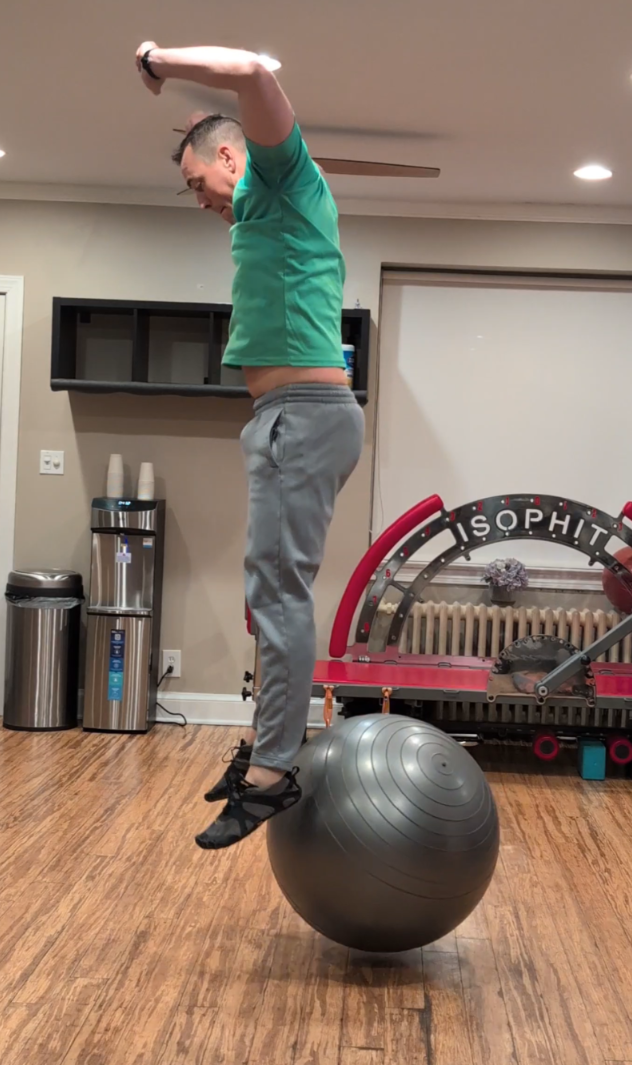
Vacher E, Sorgi H, Mathis T, Berger M, Kennouche D, Morin JB. (2026). Swiss Ball Jump to stimulate lower limb extension velocity: A proof of concept. Science Performance and Science Reports, 281.
4. Assisted Band Jumps (Acceleration)
To increase vertical jump and improve explosive force production against the ground add a super band or elastomer to sling-shot you up by increasing your jump velocity because it decreases your body weight. The lighter you are, the potentially faster you can move. This is counter-intuitive but the lighter something is the faster the velocity. This method called over-speed training will teach your nervous system to move faster, thus making you quicker and more explosive. It is a math and physics equation. Force = Mass x Acceleration (F=MxA) or Acceleration = Velocity over Time (A=V/T).

Zhou, R.Y.S., James, L.P., & Lum, D. (2025). Comparing the Force–Time Characteristics Between Countermovement and Assisted Countermovement Jump with Different Landing Strategies. Muscles.
For more Videos on Speed Agility and Quickness Drills


Comments